
Quick answer
Turkey teeth shaved down means healthy teeth cut to small stumps so that crowns can be fitted over them. A crown needs far more tooth removed than a veneer, and enamel and dentine do not grow back, so the loss cannot be undone. What can be done afterwards is repair: replacing crowns, treating nerves that have been damaged and, at worst, removing teeth. We found no study that measures how often over-preparation happens. Before any drilling, get a tooth-by-tooth plan in writing, with the amount of reduction and the alternatives.
A crown does not sit on a tooth. It sits on what is left of one. To fit it, a dentist cuts the tooth down on every side to a smaller, stump-like shape, and once that has been done to a healthy tooth, no later treatment gives the tooth back. That is the fear behind the search "Turkey teeth shaved down": a smile makeover sold on price, a row of teeth reduced to pegs, and a lifetime of repair work that the patient only understands afterwards.
This page does not say that every clinic in Turkey does this, or that crowns are never the right treatment. We found no measurement of how often it happens. What the documented cases show is what is lost, what follows, and which written answers to demand before anyone picks up a drill. If the work is already done, go to the section on whether it can be reversed. If you are still deciding, go to the five things to get in writing.
Why are Turkey teeth shaved down to pegs? Crowns need far more tooth removed than veneers
The phrase describes a crown, not a clinic. A crown is a cap that covers the whole tooth. For it to fit, the dentist has to reshape the tooth first, and the NHS says as much: the old tooth has to be shaped so that the crown can be fixed on to it. A veneer is a thin shell bonded to the front of the tooth. To fit some veneers the front of the tooth is drilled away a little, and not all veneers need even that.
Between those two ends lies a very large difference. Laboratory measurements published in 2002 on plastic teeth, weighing the tooth before and after preparation, found that porcelain veneers and resin-bonded retainers removed about 3% to 30% of the crown of a front tooth, while all-ceramic and metal-ceramic crown preparations removed about 63% to 72%. In the same study a metal-ceramic crown took away more than four times as much tooth as a veneer prepared on the front surface only. These were typodont teeth measured by weight, not patients, so read the figures as a guide to scale rather than a promise about any one mouth. The scale is the point: a crown is a much bigger subtraction.
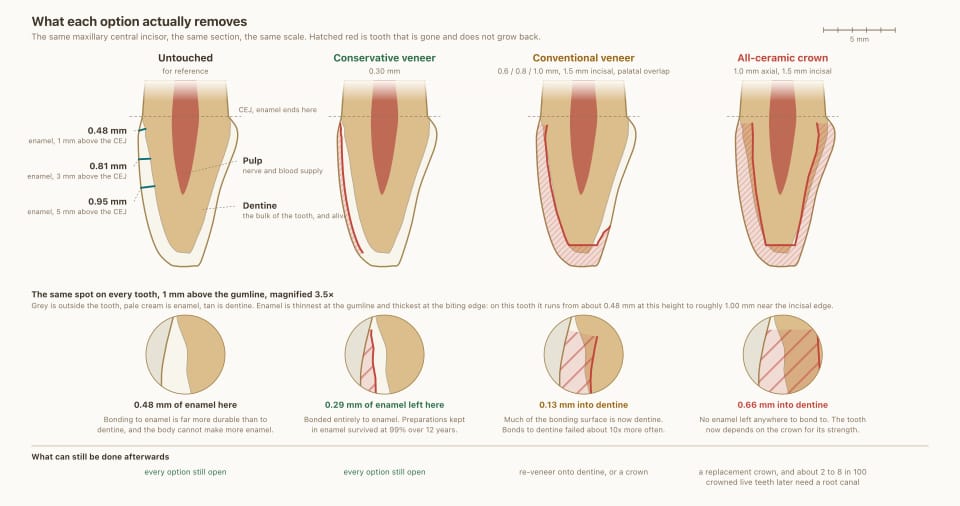
The diagram below draws the same upper front tooth after each option. The red hatching marks tooth that is gone for good.
The loss is permanent because the body does not replace it. Enamel, the hard outer layer, is thin, and once a preparation has cut through it, what was removed stays removed. A dentist can add material to a tooth. A dentist cannot grow it. And a cut-down tooth now depends on its crown for its shape and strength for the rest of its life, which is why a crown is replaced by another crown, not taken away.
Why would anyone choose that for a healthy tooth? Sometimes there is a sound reason: a tooth that is badly broken, worn, heavily filled or very misaligned may need the coverage a crown gives. The trouble starts when the reason is price per unit and speed. A package that quotes "twenty crowns" turns a clinical decision into a number. Nothing on a quote tells you whether each of those teeth was assessed for a lesser treatment first.
This is not a Turkish problem alone. A cosmetic dentist wrote in a dental trade publication in July 2022 that many UK dentists were cutting teeth down to crowns when minimal-preparation veneers could have been used. The same piece reported that some dentists argued on forums that the public had every right to get twenty discounted zirconia crowns if the aesthetics improved their quality of life. The argument inside dentistry is therefore not that crowns are wrong. It is about whether the person understood, before the drill, what each tooth would lose and what the alternatives were. Our guide on veneers or crowns defines the two treatments, and composite bonding versus veneers covers the least invasive route.
What does a UK dentist see afterwards: nerve damage, root canals, joined crowns?
Four accounts and one survey are documented. Each account is told here as one person's experience, not as a rule.
A refusal in the UK, then a holiday. A medical defence organisation published an anonymised case file in October 2025. A UK dentist examined a 29-year-old man and declined to place the crowns he wanted. Many of his teeth were misaligned, so the crowns would have needed heavy cutting, and the dentist judged that there was a significant risk of damage to the nerves. The man left the consultation before the discussion had finished. About a month later he came back after a holiday in Turkey, with a run of six front crowns, from one upper canine to the other, fitted there. He had jaw ache, general sensitivity, pain in four or five teeth, sore gums and trouble speaking. X-rays showed changes at the root tips of three teeth that the dentist thought were probably nerve-related and in need of root canal treatment. A restorative specialist later replaced many of the crowns, he needed several root canal treatments, and he was seeking a refund with no certain outcome. This is one anonymised case, told from the UK dentist's side. It does not tell us what the Turkish dentist's reasoning was, and it does not show that every patient with six crowns has this outcome. It does show what a UK dentist judged too risky to do, and what followed when it was done anyway.
Three crowns needed, twenty fitted. In May 2025 an Irish reconstructive dentist, until that month president of the Irish Dental Association, described a patient who needed only three crowns and whitening but came back with twenty crowns from abroad. He said that the crowns are often bonded together, so you cannot floss between them, which can lead to gum infection and pain, and that he sees about six such patients a month. The report said that putting such work right can cost Irish patients a five-figure sum in euros in the worst cases, on top of what was paid for the original treatment. That is one dentist's account, and the figure is a ceiling for the worst cases, not a typical bill.
Aggressive drilling. Dr Alex Foo, a dentist, speaking to a European news channel in October 2024, said that clinics aimed specifically at UK and Irish patients tend to use aggressive techniques, including excessive drilling that can cause significant damage to teeth, and that some patients end up needing dentures. The report of his comments adds that over-drilling to prepare teeth for crowns or veneers can lead to nerve damage, and that some patients have returned with severe infections which can destroy the underlying bone. It also says that severe infection can make implants impossible. The nerve, bone and implant statements are the news report's own narration of the risk, not Dr Foo's quoted words, so treat them as a report of what dentists warn about.
Root canals, gum disease and no temporaries. In a March 2023 column in the same trade publication, a cosmetic dentist wrote that patients who arrive after crown work abroad have teeth drilled down to pegs, that many needed a high number of root canals, that some developed gum disease, and that some were given no temporary teeth between preparation and the final crowns. She also described a treatment plan for twenty zirconia crowns on what she called a perfect mouth. This is a clinician's opinion piece. It tells us what one UK dentist sees in her own surgery, not how common it is.
How widespread is it? A survey of 1,000 UK dentists reported in July 2022 found that, among those who had treated patients after treatment abroad that had gone wrong, 76% said patients were experiencing pain, and that crowns were the treatment most often needing follow-up, ahead of implants. The survey covered treatment abroad generally, not Turkey alone, and it counts dentists who saw patients with problems. It cannot say how often treatment goes wrong, because people whose crowns hold up do not turn up in a dental surgery or a newspaper. In the same survey, among the dentists who had treated patients with problems, 65% estimated that putting it right would cost £500 or more.
Two things follow. First, the damage is clinical, not cosmetic: pain, infection, a nerve that has to be treated, gums that cannot be cleaned. Second, the decision that matters is made before treatment starts, which is where the checks later in this page apply. For the wider picture see Turkey teeth gone wrong, and for the style of offer that puts a number of crowns in the quote, our guide to the Hollywood smile in Turkey.
Can shaved-down teeth be reversed, and can you reverse Turkey teeth?
The tooth structure cannot be reversed. No crown, filling or material restores what was cut away in the sense of making the tooth as it was. What is possible is repair around the loss, and it differs from case to case.
What remains possible. A dentist can examine the crowns and the teeth beneath them, take X-rays and judge which crowns fit badly or are failing. Poorly fitting crowns can be replaced. A tooth whose nerve has been damaged or infected can be treated with root canal treatment, as in the case described above, where many crowns were replaced and several root canals were needed. Where a tooth cannot be saved, it can be removed and replaced with an implant, bridge or denture. A dentist quoted in a news report said some patients end up needing dentures.
What does not come back. The enamel and dentine that were removed, the tooth's original shape and the option of a simple treatment. A person whose teeth were healthy and could have been improved with whitening or bonding no longer has that choice. Once a tooth has been prepared for a crown there is no enamel left on its surface to bond a thin veneer to, so the route back to the least invasive option is closed. Ask a dentist about your own teeth before assuming how much remains.
What to do now. If the work has been done and something hurts, see a dentist. Pain, swelling or fever should not wait for a complaint. Bring everything you were given: the quote, messages, consent form and any X-rays. Ask for an assessment and X-rays of all the crowned teeth, and ask which crowns are the priority. Ask early whether the practice will take on the repair and what it would cost. Write to the clinic with the dates and what you want, and keep the reply or the silence. Our guide on Turkey teeth gone wrong sets out the complaint and payment routes.
What to keep in perspective. Many people have crowns that function for years, and we found nothing that measures how many. A well-made crown on a tooth that truly needed it is a proper treatment. The aim of this section is not to say the work was wrong in your case. It is to say that if the plan was heavy reduction on healthy teeth, the useful time to question it was before the drill.
Why are crowns a lifetime commitment, and who pays when you are back home?

A crown is not a one-off. An NHS hospital patient leaflet says a crown or veneer should normally last around 8 to 10 years with proper care, depending on check-ups, brushing and flossing technique, and sugar in the diet. That is a normal life, not a failure. But it means that a mouth of crowns is a set of repeat bills. A person crowned at thirty and living into their seventies faces several rounds of replacement, each one at the price of the day. Our guide on how long Turkey teeth last covers what is known about replacement.
That arithmetic is why heavy reduction is a decision about decades, not a holiday. Twenty crowns bought on a discount now are twenty crowns to replace later, probably at UK or Irish prices. The NHS says veneers are generally only available privately unless you can show a clinical need, so a cosmetic plan at home is likely to be a private cost too. Ask a UK practice how it would handle a failing crown from abroad, and ask it to itemise the cost.
Three costs rarely appear in a Turkish quote:
- Replacement. Every crown has a date when it will need replacing. The quote prices the first one only.
- Treatment of what the preparation damaged. Root canal treatment, gum treatment and extractions are separate fees at home.
- A second opinion before you travel. An examination with your own dentist, with X-rays and a view on the plan, is a cost at home. It is also the cheapest way to find out whether a lesser treatment would do.
None of these is certain to arise, and none is a reason to rule out treatment abroad. Each is a figure to put next to the quote before you compare totals. If you are weighing the whole package, the Hollywood smile guide explains how such offers are built.
Before anyone drills: what five things should you get in writing?
You cannot see inside a quote, and you cannot undo a preparation. So the checks that matter come before treatment, and each is a written answer. These five are distinct; the checklist below mirrors them.
1. A plan made after an examination of your own teeth
A price quoted from selfies describes a smile, not your mouth. Ask for the plan to be issued after a dentist has examined you and taken X-rays or a scan, and for a copy before you travel. Show it to your own dentist first. If the plan grows after you arrive, with more teeth or a switch from veneers to crowns, treat it as a new offer: in writing, with time to think and the right to go home.
2. A tooth-by-tooth plan that names the restoration and the reduction
For each tooth: veneer, crown or something less, and why. How much preparation is planned, and how close that comes to the nerve. What was considered instead, including whitening, bonding or leaving the tooth alone. "Full smile design" or "twenty units" is not a plan. If someone asked for veneers, the document should say veneers, and say what happens if the dentist decides on crowns once the work has begun: you decide, in writing, before the drill, not after.
3. Written consent that says the steps cannot be undone
A consent form should state that removing tooth structure is permanent, list the alternatives and say who explained them. Ask how long you have between the consultation and the first preparation, and whether you can change the plan or stop after the first tooth. A consultation and drilling on the same day leaves no room to think, and that is exactly the room you need.
4. Who treats you, and what you wear in between
Ask for the full name and registration details of the dentist who will prepare your teeth. Compare the name with the doctors the clinic's register entry records; a name that does not appear is a question to put to the clinic, not a disqualification, because entries can be out of date. Ask whether that dentist is in the chair throughout. Then ask what you will have on your teeth between preparation and the final crowns, because one UK dentist has described patients who were given no temporary teeth at all.
5. What happens when a tooth hurts or a crown fails
Ask for the guarantee in writing, how long it lasts and what counts as failure; whether root canal treatment or replacement of crowns is covered, and where; who pays for flights and hotel; whom you contact from home and how fast they answer; and the clinic's complaints procedure. Ask for X-rays taken before treatment, the preparation records, the materials used and a copy of the consent form when you leave. A dentist at home who cannot see how much was removed has to guess. If you can, pay by UK credit card, which can give you a claim against the card provider for items costing over £100 and up to £30,000, including part payments; ask your issuer whether your package qualifies before you pay. A debit card payment may allow a chargeback instead. In Ireland the card route is a chargeback on a credit or debit card, with a time limit set by the card scheme.
Copyable checklist
- Plan: made after a dentist examined my teeth with X-rays; shown to my own dentist; changes on arrival in writing
- Each tooth: veneer, crown or less, with the planned reduction, the reason and the alternatives considered
- Consent: states that tooth removal is permanent; time to think before the first preparation; right to stop
- Dentist: full name and registration details; compared with the register entry; temporary teeth explained
- If it fails: guarantee, root canal and crown replacement cover, flights and hotel, contact route, complaints procedure, records and X-rays on departure
Already chosen a dental clinic in Turkey?
An investigation checks the official registration, the provider details and the claims the clinic has made, including its treatment promises, against documents.
Clinic Investigation £29
One clinic. Evidence-based research. Clear findings and limitations.
Investigate my clinicHow does an independent check test the clinic's promises?
The register, the Ministry of Health list of facilities authorised to treat international patients, can be searched with Clinimora's register search. It answers one question: is this facility authorised? An entry records the facility's official name, authorisation number, type, address, the doctors recorded against it and a website where one is on file. It does not record which treatments the facility performs, who performs them on a given day, how much tooth they remove or what patients say afterwards. A match means authorised, not that the work is good.
Everything in the five checks above is a claim the clinic makes or a document it should hold, and those can be tested. A Clinic Investigation takes one named clinic and builds a dossier on the questions the register leaves open: who the company is, whether the facility is authorised under the name on your contract, which doctors are recorded against it and whether they match the dentist you were promised, and what the clinic's own website, quote and messages say about veneers, crowns, guarantees and aftercare. Where its promises do not match its documents, the dossier says so, with the evidence.
It does not examine your teeth, and it cannot tell you whether you need crowns. That is a dentist's job, and the first thing to ask your own. What the investigation gives you is the research on the clinic, with findings and limits stated, before you pay a deposit for treatment you cannot take back. Clinics cannot pay Clinimora for anything. See the Research Pass.
Frequently asked questions
Can you reverse Turkey teeth?
The tooth that was cut away cannot be put back, so the shaping itself is permanent. What a dentist can do is replace poor crowns, treat nerves that have been damaged with root canal treatment and, in the worst cases, remove a tooth and replace it. Ask your own dentist for an assessment with X-rays before deciding anything.
Does every Turkey teeth package involve filing teeth down?
No. Crowns need heavy reduction; veneers, bonding and whitening need far less or none. The concern is a plan that counts units, such as twenty crowns, without saying why each tooth needs one. The Ministry of Health register records that a facility is authorised, not which treatments it performs, so the plan itself is what to examine.
Can Turkey teeth die and leave a dead nerve?
Cutting a tooth down can injure the nerve inside it. Dentists describe prepared teeth that later needed root canal treatment or were lost, and the UK case described in this article shows root-tip changes on three teeth a month after crowns were fitted abroad. We found no figure for how often it happens, so ask the dentist how close the planned reduction comes to the nerve.
Do Turkey teeth need root canals?
Some do. In a documented UK case, three teeth showed changes at the root tip that the treating dentist thought probably came from the nerve and needed root canal treatment, and several more root canals followed. Many teeth never need one. Pain, sensitivity to hot or cold, a swollen gum or a bad taste around a crowned tooth is a reason to see a dentist promptly.
What do Turkey teeth look like before and after?
Before-and-after photographs show the finished smile, not the stumps under it. That is why the photographs cannot answer the question that matters: how much of each tooth was removed. Ask the clinic for the preparation plan for each tooth, and for X-rays of your own teeth before treatment, so a later dentist can see what changed.
How do I know if my teeth were over-prepared?
Only a dentist who examines you and takes X-rays can say. Signs that justify an early appointment are pain, sensitivity, sore gums, crowns that are bonded together, or a plan that changed on arrival. Keep the quote, the messages, the consent form and any photographs of the work, because they show what was promised and what was done.
Are crowns from a Turkish clinic safe if the dentist is experienced?
The dentist's experience matters, but it does not replace the plan. A crown is a permanent decision for each tooth, and every case needs an examination, X-rays, a reason for each crown and a written account of the alternatives. Ask for the dentist's full name and registration details, and compare the name with the doctors the register records for the facility.
Who pays if shaved-down teeth need replacing at home?
Unless the clinic's written guarantee covers it, plan on paying yourself. UK dentists have estimated that putting right treatment abroad often costs hundreds of pounds or more, and an Irish newspaper has reported a dentists' association saying that removal and replacement can reach a five-figure sum in euros. Ask the clinic before paying who covers flights, hotel and remedial work.