
Quick answer
'Turkey teeth gone wrong' usually describes one of two things: healthy teeth ground down for crowns that were sold as veneers, or implant work that becomes infected or fails. We have found no study that measures how often this happens, and people also come home with work that holds. If it has gone wrong, see a dentist soon, keep every record and put your complaint to the clinic in writing. Before paying, make seven checks; as of 28 October 2026 the Ministry of Health register lists 1,287 dental facilities, but it records authorisation, not which treatments a facility performs.
"Turkey teeth" is a label, not a clinical term. When people say the work has gone wrong, in the cases that get reported they usually mean one of two things: healthy teeth that were ground down further than they needed to be, or implant treatment that turned painful or infected after they got home. Neither is inevitable, and neither is rare enough to ignore.
This page starts with what goes wrong, because that is what the search asks. If something hurts now, go straight to the section on what to do if your teeth have already gone wrong. If you are still deciding, the seven checks near the end are for you.
What actually goes wrong?
Four patterns come up again and again in what UK dentists describe and what patients report.
Too much tooth removed. A veneer is a thin shell that needs little preparation. A crown covers the whole tooth, which has to be reduced on every side. Dentists in the UK describe patients who believed they were having veneers and had crowns, on teeth that were healthy. Enamel does not grow back, so a reduced tooth needs a crown, and later a replacement crown, for the rest of its life. Our guide to veneers or crowns shows how much is removed and what the research says; how long Turkey teeth last covers replacement.
Nerve damage and infection in prepared teeth. Reducing a tooth can injure the nerve inside it. Dentists describe teeth that die and abscesses that need root canal treatment or end in extraction. Patients quoted in the press describe lasting pain and infection.
Poor fit. A crown or veneer that does not meet the tooth cleanly leaves a gap at the edge where decay can start unseen underneath.
Implant trouble. Implants can become infected or lose their bone support, and problems may appear well after the trip. Sinus lifts and bone grafts, which are sometimes added to an implant plan, are additional surgery with their own risks. Problems are also harder to treat at home when the next dentist does not know which implant system was used.
How serious can it get? At the mild end, work has to be redone earlier than it should be. At the other end, people describe long courses of repair, loss of teeth and, after implant surgery, infections that need specialist care. In a 2022 survey of UK dentists, 86% said they had treated people suffering consequences of treatment abroad; 65% put the cost of remedial work at £500 or more, and 20% estimated a cost above £5,000. That survey counts dentists who have seen such patients, not how often treatment fails; we have found no study that measures that.
What have patients described?
One patient told a regional UK newspaper that she had four implants placed in Türkiye after earlier veneers there, and that the clinic suggested a sinus lift, a bone graft and replacing her veneers with implants. She was later reported to have a serious infection, and an X-ray from a private dentist was reported to show the implants piercing her nose; she was also reported to have been unable to get treatment from an NHS dentist. This is a press account of one person's experience, relayed second-hand. It does not show that the clinic was at fault or that any check would have prevented it. A pre-travel scan and a second opinion would have given her a record of what the bone looked like beforehand, and an independent view of the larger plan.
There are also patients whose work holds up for years. They are rarely in these stories, because few people write about a dental trip that went unremarkably, which is one reason no reliable failure rate exists.
Why does it happen?
Most of the reported problems start before anyone picks up a drill.
- The plan comes before the examination. A price quoted from selfies describes a smile, not your mouth. A qualified dentist should assess you, including your medical history, smoking and earlier surgery, before any plan or cost is given.
- Reduction is fast and cannot be reversed. For some people bleaching or bonding gives a satisfactory result with far less loss of tooth. A plan that counts units ("20 veneers") rather than giving a reason for each tooth skips that question.
- A short trip leaves little room. There is limited time to see how teeth and gums settle before the next step, and little time to change your mind.
- Records stay behind. Without X-rays, the plan, consent forms and implant details, your next dentist works blind.
- Nobody owns the problem afterwards. The clinic is in another country, and the coordinator who answered within minutes before the deposit may not do so afterwards.
Good dentistry is also practised in Türkiye. The concern is mass, uniform treatment sold on price, not the country.
What should I do if my Turkey teeth have already gone wrong?
- Pain, swelling or fever come first. See a dentist or urgent care now. The complaint can wait a day; an infection should not.
- Get assessed. Book a dentist where you live, ideally your own. Take everything you were given. Ask early what they can do and whether they will take on repair, because some private dentists decline work they did not start, and the NHS position, as reported, is emergency care rather than repair of cosmetic work done abroad.
- Keep every record. Messages, quotes, invoices, consent forms, X-rays, photographs of the problem, screenshots of what the clinic promised, and dated notes of your symptoms.
- Write to the clinic. State what is wrong, what you want, and by when. A written reply, or silence, is evidence either way.
- Use the Turkish complaint channels. The Ministry of Health takes complaints from international patients; how to complain about a clinic in Türkiye lists them, and your rights as an international patient explains what you can reasonably expect.
- Do not rely on a UK regulator. The GDC deals with dentists on its own register; it cannot guarantee that an equivalent body exists abroad.
- Ask your card issuer. If you paid by credit card, ask whether a claim is possible (see check 6 below). A debit card payment may allow a chargeback.
Whether you get money back depends on the contract, the evidence and how you paid. No route guarantees it.
How can I reduce the risk before paying?
Seven checks, in this order. Each is a question the clinic must answer in writing, apart from the first, which you can do yourself.
1. Is the clinic on the register?
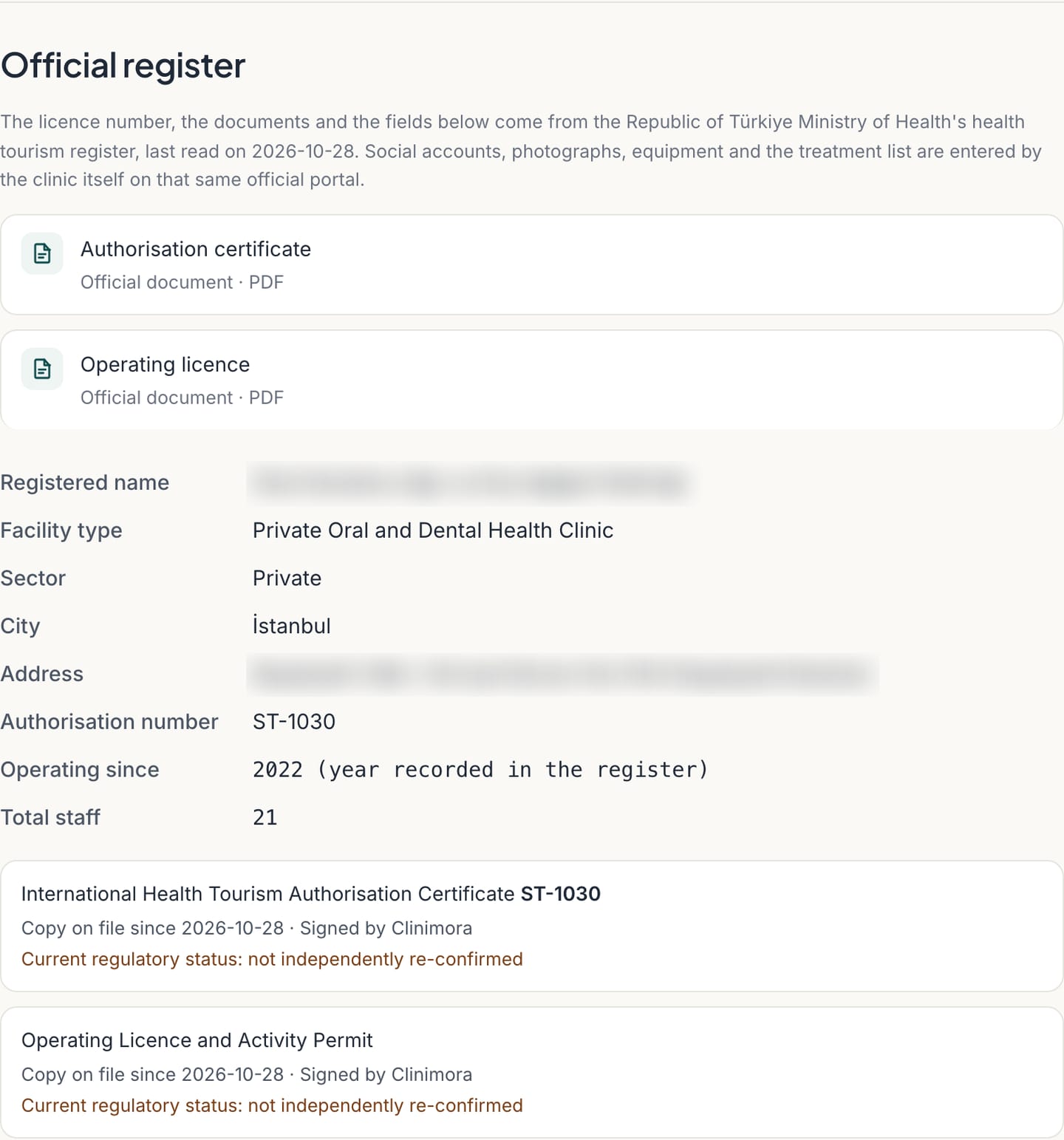
"The register" is the Ministry of Health list of facilities authorised to treat international patients. As of 28 October 2026 it holds 4,303 facilities across 60 cities, and 1,287 are recorded as dental: clinics, dental centres and dentists' offices. Istanbul has 533 of those and Antalya 260. You can search it with Clinimora's register search.
An entry records the facility's official name, authorisation number, type, address, the doctors recorded against it and a website where one is on file. It does not record which treatments the facility performs, who performs them on a given day, prices or complaints. A match means authorised, not good. See reading an authorisation number and what an ST number is. The name on the register should be the name on your contract and your payment details; if a trading name differs, ask the clinic to explain.
2. Who will treat you?
"Our expert team" is not an answer. Ask for the full name of the dentist who will prepare your teeth and their registration details, then compare the name with the doctors recorded on the facility's register entry. A name that is missing from the entry is a question to put to the clinic, not a disqualification: an entry can be out of date or spell a name differently. Ask whether that dentist will be in the chair throughout and whether anyone else carries out any part.
3. Will a dentist examine you before the plan?
Ask for the plan after an examination, with X-rays or a scan of your own teeth. Show the quote to your own dentist first; they know your history and should know your plans in case you need help later. If the plan grows after you arrive, with more teeth, a sinus lift or a bone graft, treat it as a new offer: in writing, with time to think.
4. Does the plan say veneer or crown, tooth by tooth?
For each tooth: the restoration planned, how much preparation is expected, and what alternatives were considered, including whitening or bonding. "Full smile design" with no more detail has not told you what the clinic intends to do. Keep the plan and every promise made in messages; if the finished work differs, that is your evidence. The veneers or crowns guide has the detail.
5. What does the deposit commit you to?
A deposit should hold a date, not commit you to a plan you have not seen. Get in writing: the amount, whether any is refundable and until when, and what happens if the plan changes or you decide not to proceed after the examination. Ask whether you are dealing with the clinic or a booking company, and whose name goes on the invoice. The twenty-five questions to ask before paying a deposit go further.
6. How are you paying?
If you can, pay by UK credit card. For items costing over £100 and up to £30,000, the card provider can be jointly liable with the seller for a breach of contract or misrepresentation, which can apply to purchases made abroad and where only a deposit went on the card. It does not apply to debit cards, and it may not apply where the payee is an agent for the supplier; ask your issuer whether your package qualifies before you pay.
7. What happens when something needs fixing?
Settle this before you fly. Ask for the guarantee in writing, with its length; who pays for flights, hotel and remedial work; who you contact from home and how fast they reply; which materials and implant brand will be used, in writing; and a copy of your X-rays, treatment record and invoice on departure. Ask to see the clinic's complaints procedure. Our guide on what records to ask for lists what to request, and guarantees and travel insurance covers what cover actually does. Arrange a UK dentist for check-ups before you leave.
Copyable checklist
- Register: clinic found; legal name matches contract and payment details
- Dentist: full name and registration details asked for; compared with the doctors on the register entry; any gap put to the clinic
- Examination: assessment with X-rays or scan of my own teeth before the plan; quote shown to my own dentist; changes after arrival in writing
- Plan: each tooth listed with restoration, expected reduction and alternatives
- Deposit: amount, refund terms and what happens if the plan changes, in writing; clinic or booking company confirmed
- Payment: UK credit card; issuer asked about my package
- Aftercare: guarantee, remedial costs, contact route, materials, records on departure and complaints procedure in writing; UK dentist arranged
How does Clinimora investigate a clinic?
The register tells you whether a facility is authorised. It does not tell you what the clinic's own paperwork shows, whether the recorded doctors are the ones who will treat you, or whether its promises hold together. A Clinic Investigation takes one named clinic and builds a dossier on those questions, with the findings and their limits stated. Clinics cannot pay Clinimora for anything. If the clinic is one we have already investigated, the Ready Clinic Report (£59) is the quicker option. How Clinimora works explains the method.
Already chosen a dental clinic in Türkiye?
An investigation checks the official registration, the provider details and the claims the clinic has made, against documents.
Clinic Investigation £79
One clinic. Evidence-based research. Clear findings and limitations.
Investigate my clinicFrequently asked questions
What if my Turkey teeth have already gone wrong?
Pain, swelling or fever mean seeing a dentist or urgent care now, not after the complaint. Otherwise book an assessment with a dentist near you, ideally your own, and bring every record you have. Write to the clinic setting out the problem and what you want, with dates. Keep all messages, invoices, X-rays and photographs.
Will the NHS fix Turkey teeth?
Not as a matter of course. Emergency care is available; routine repair of cosmetic work done abroad is reported not to be, and some private dentists also decline such work. Ask a dentist early what they can do, and ask what happens if you need urgent help.
Can I get my money back?
There is no guarantee. The routes are a written complaint to the clinic, the Turkish complaint channels, and, if you paid by credit card, a claim through the card issuer, which depends on the amount and how you paid. A debit card payment may allow a chargeback.
Is it safe to get teeth done in Turkey?
It depends on the clinic, the dentist and the plan, not the country. The recurring concern is heavy, irreversible tooth reduction that was never clearly explained. The seven checks on this page are designed to bring that out before you pay.
How often do Turkey teeth go wrong?
We have found no study that measures it, and people whose work went well rarely show up in a UK surgery or a newspaper. Be wary of anyone who quotes a percentage in either direction.
Can the GDC help if my treatment in Türkiye goes wrong?
The GDC regulates dental professionals on its own UK register and cannot guarantee that an equivalent body exists abroad. If the work was not done by someone on the UK register, you will need the clinic's own complaints route and the Turkish channels.