
Quick answer
A Clinimora Clinic Investigation is a dossier on one named clinic. It opens with a decision brief of four indicators and the key findings, then sets out each claim the clinic made as a card with its status, its importance, what was found, the evidence and a next step, and ends with the clinic's answers to written questions and a register of evidence. The public sample uses a fictional clinic. It shows no single score, and a finding that could not be confirmed is marked as unverified, which does not mean it is false.
Before you pay for research on a clinic, it helps to know what you would receive. Clinimora publishes a sample report for that reason. This page walks through it. The clinic in the sample is fictional: the page states that it does not exist and that nothing in it describes a real clinic, doctor or price.
What is the sample report?
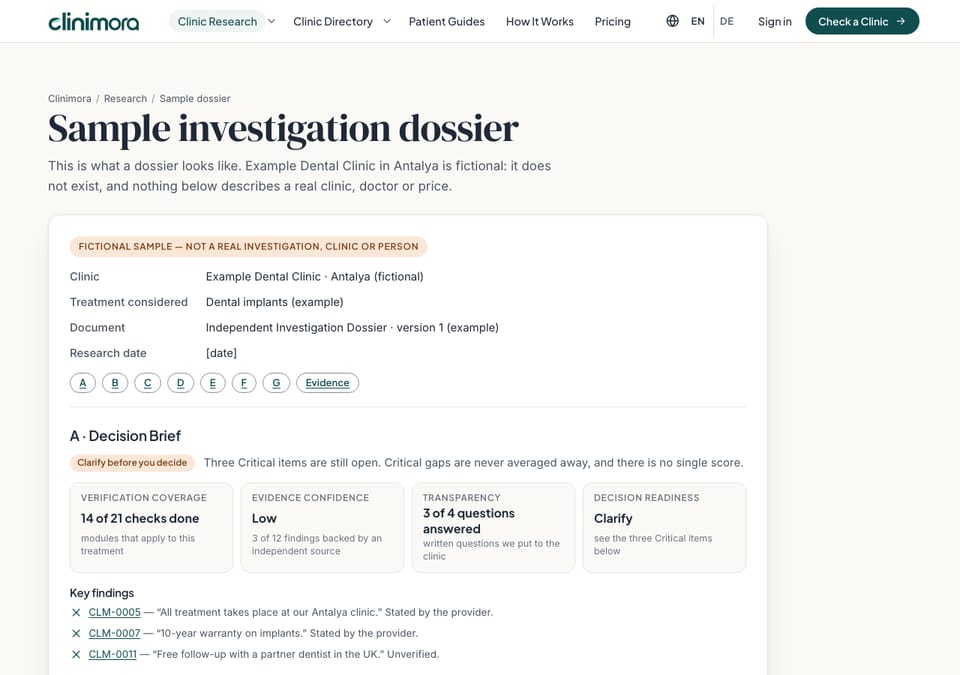
It is an example of an Independent Investigation Dossier, the document a Clinic Investigation produces for one named clinic. The sample covers a made-up dental clinic in Antalya and a made-up dental implant plan. The research date is left as a placeholder.
The report is divided into sections A to G, followed by an evidence register. The short version is that sections B to F hold the findings, grouped by subject, A summarises them, and G holds the questions put to the clinic and what came back.
What does the opening summary say?
Section A, the Decision Brief, opens with four indicators. They are deliberately separate, and there is no single score; the page says critical gaps are never averaged away.
- Verification coverage shows how many of the checks that apply to the treatment were done. In the sample: 14 of 21.
- Evidence confidence shows how many findings are backed by an independent source. In the sample: 3 of 12, and the indicator reads Low.
- Transparency shows how many of the written questions put to the clinic were answered. In the sample: 3 of 4.
- Decision readiness is a plain-language line. In the sample it reads "Clarify", because three Critical items are still open.
Below the indicators come the key findings, a suggested next action, and four short statements: what was confirmed, what remains uncertain, what raises concern and what the reader should do next. In the sample, the suggested next action is to send the clinic three written questions and not to pay a deposit until the answers are in writing.
How is each finding set out?
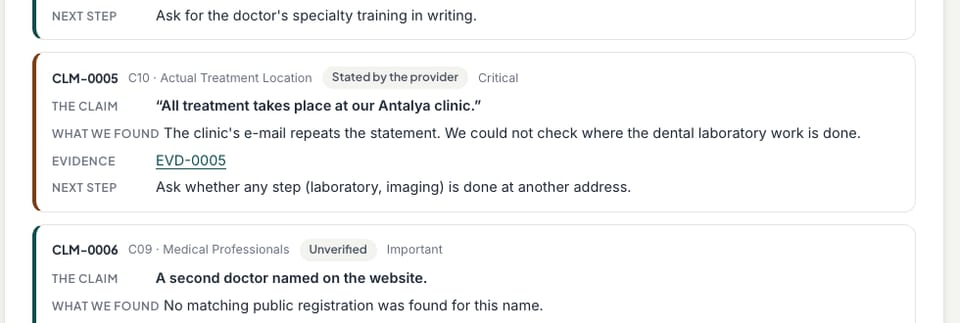
Each finding is a card, and every card has the same parts: a claim number, a module code and subject (for example, Government Authorisations or Medical Professionals), a status label, an importance level, the claim as the clinic made it, what was found, the evidence references and a next step.
The sample's claims are the sort a patient meets in a clinic's own messages: that the clinic is authorised for international health tourism, that it is operated by a named company, that all treatment takes place at one address, that a warranty runs for ten years, that a partner dentist in the UK provides follow-up. The next step on each card is a specific request, such as asking for the warranty terms in writing or the name of the UK practice.
What do the status labels mean?
The sample uses five status labels, with three levels of importance (Critical, Important, Informational).
- Independently verified. In the sample, the clinic is listed as authorised in the official register and the register extract names the same address as the clinic's website. The next step is to keep the extract and check the entry again shortly before travelling.
- Corroborated. In the sample, a trade-registry gazette entry shows a company of the stated name at the same address.
- Stated by the provider. The claim comes from the clinic's own website or email and could not be checked independently. In the sample, the clinic repeats that all treatment is on its premises, but where the laboratory work is done could not be checked.
- Unverified. No public source was found. The sample states that this does not mean the claim is false.
- Pending response. A question was put to the clinic and has not been answered. In the sample, the written quotation lists the implants but not the final crowns, and the clinic had not replied.
The sample also shows what the labels do not do. A claim with no evidence says "none found" and is not treated as a finding of fault.
What are sections B to G?
- B, Provider Identity: the authorisation, the operating company and any group the clinic says it belongs to.
- C, Clinical Investigation: the named doctors, whether a public registration was found for each, and where treatment takes place.
- D, Trust Investigation: marketing claims, such as a warranty or a number of procedures, and whether a public source exists for them.
- E, Financial Investigation: the written quotation, payment and cancellation terms, and a cost picture. The sample's cost table is marked as a hypothetical illustration with invented amounts, to show the layout of package price, flights, accommodation, local costs and an allowance for an extra visit. A real report uses the figures in your own quotation.
- F, UK Patient Protection: aftercare and continuity, including what records the clinic says it will give your own dentist.
- G, Final Deliverables: the open questions and the clinic's answers, as answered or no response yet. Unanswered questions are shown as pending, and the sample says the dossier updates when the clinic replies.
The evidence register at the end lists each source by kind, institution and access date, and every finding points to the rows it rests on.
What does a report not do?
The Research page is direct about this: a Clinic Investigation does not check medical quality, treatment results or a doctor's clinical skill. A report is an information service, not medical advice, and records can change after the research date.
It also does not rank clinics or recommend one. Clinics cannot pay Clinimora for anything, and clinics cannot pay for ranking. How Clinimora works sets out the method, the independence rules and how contacts with authorities are logged.
What does a Clinic Investigation include?
The scope covers licensing and official records, doctors and qualifications, ownership and company background, patient reviews and reported concerns, pricing, guarantees and aftercare, and evidence-backed findings with the questions still open. The report is available in your dashboard and as a PDF. The same page lists what is not included, including a review of your own quote or contract, which is available separately on request.
You can do some of these checks yourself first: how to verify a clinic's authorisation, how to check a doctor, what a quote should itemise and which records to ask for. The register search is at register search.
Already chosen a clinic in Türkiye?
An investigation checks the official registration, the doctors named to you and the claims the clinic has made, against documents.
Clinic Investigation £79
One clinic. Evidence-based research. Clear findings and limitations.
Investigate my clinicChecklist: reading any clinic research report
Ticks stay on this page only; nothing is saved or sent.
Frequently asked questions
Is the sample report a real clinic?
No. The sample describes a fictional dental clinic in Antalya, and the page says that nothing on it describes a real clinic, doctor or price. It exists to show the layout and the way findings are labelled.
Does the report give the clinic a score?
The sample shows four indicators and a decision-readiness line, not a single score. The page says critical gaps are never averaged away.
What does unverified mean in the report?
That no public source was found for the claim. The sample states that this does not mean the claim is false.
Does the report assess medical quality?
No. The Research page lists medical quality, treatment results and a doctor's clinical skill as not checked, and calls a report an information service, not medical advice.
What happens if the clinic does not answer a question?
The question is shown as pending, not as bad news, and the sample says the dossier updates when the clinic replies.
Can a clinic pay to change its findings?
No. Clinics cannot pay Clinimora for anything, and no finding or verification result is for sale.