
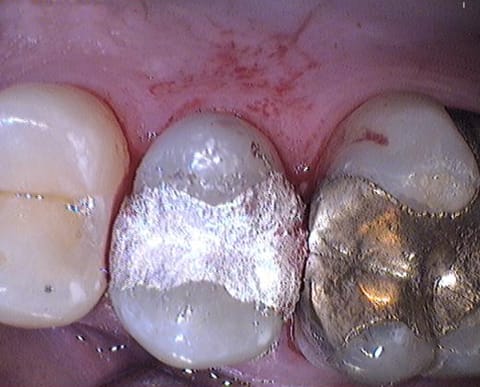
What it is
Amalgam is a filling material made from a mixture of mercury, silver, tin and copper and is one of the filling types dentists use. Many adults have amalgam fillings placed years ago.
The register lists a treatment heading, "Smart Amalgam Removal". SMART is the name of a protocol published by the International Academy of Oral Medicine and Toxicology (IAOMT), which describes it as a set of steps to reduce mercury exposure for patients, dental staff and office staff when amalgam is removed. A "SMART certification" signifies that a dentist has completed the IAOMT's educational programme, and the IAOMT says the dentist decides the specific methods used in their own practice. The heading on the register does not tell you whether a facility follows that protocol, a different one, or none; it records only that the facility listed the treatment.
Who it is for, and who it is not for
The first question is whether removal is needed. The FDA's advice is that a filling in good condition, with no decay underneath, should not be removed, because removal causes unnecessary loss of healthy tooth structure and a temporary rise in mercury vapour. It suggests people with a mercury sensitivity or a neurological or kidney condition discuss removal with their dentist or physician first. A filling that has decayed underneath, broken or worn out is a different case, and replacing it is ordinary dentistry.
On whether amalgam itself is a hazard, a European scientific committee reported in 2015 that, on current evidence, neither amalgam nor the alternative materials are harmful to the general population, and that mercury release from a filling is extremely low over its lifetime, though release is transient during placement and removal for patients and dental staff. The same committee said information on the toxicology of the alternative materials was very limited. The FDA names groups that may be at greater risk from mercury vapour from amalgam: pregnant women and those planning pregnancy, nursing mothers, children (especially under six), people with a known sensitivity or allergy to mercury or amalgam components, and people with neurological impairment or kidney dysfunction. For these groups it advises avoiding amalgam for new fillings where possible.
In the European Union, a regulation of 2024 prohibits the use of dental amalgam for dental treatment, keeping an exception for patients with specific medical needs when judged strictly necessary by the dentist. That is a rule about new fillings, not about removing old ones, and it is not Turkish law. We have not verified Türkiye's own position.
How it is done in Türkiye
Removing an amalgam filling means drilling it out and replacing it, usually with a tooth-coloured material. The point of any protocol is to limit the mercury vapour and particles produced while drilling. The IAOMT publishes its steps, and cites a 1998 study reporting that a rubber dam (a sheet isolating the tooth) significantly reduced the peak of mercury in plasma after removal, and studies reporting that water spray coolant reduced vapour levels during removal. Most of what we found about SMART's individual steps comes from the IAOMT and its affiliates. We have not found an independent trial that compares SMART with other removal precautions, and we found nothing specific on high-volume suction in the sources we read. The FDA's patient page does not describe removal methods and tells patients to ask their dentist what precautions they take.
Under the Ministry of Health's regulation on private oral and dental health facilities, intra-oral work must be done by a dentist, records must show treatment by tooth number, interventions require a consent form, and promotion may not include misleading or exaggerated claims or claims that are not scientifically proven. We have not found a Turkish rule that sets a protocol for amalgam removal or requires any certification.
What to check before you book
- Need. Ask for the finding on each filling: decay beneath, cracks, wear, a failing margin. If the reason is "the amalgam itself", ask for the basis in writing.
- Your own dentist. Show the plan to your dentist at home, particularly if you are pregnant or planning to be, nursing, have a kidney or neurological condition, or a known sensitivity to mercury.
- Which protocol. Ask which removal protocol the clinic follows and what it comprises: rubber dam, suction, water spray, air supply, protective measures for you and for staff. Ask for the steps in writing.
- Certification. If the clinic cites SMART, ask who certified the dentist and when. It is a training credential from a private organisation, not a Turkish licence.
- Claims. Ask what any health claim, such as improvement in symptoms, rests on. We have not verified evidence for such claims.
- Replacement material. Ask which material will replace each filling, and from which manufacturer.
- Records. Ask for a record of each tooth treated, the steps followed and the material used.
What a package must state
- the teeth and fillings involved, by tooth number, and the reason for each removal;
- the removal protocol, in writing, step by step;
- the replacement filling, crown or inlay for each tooth, with material;
- whether examination, X-rays, anaesthetic and any follow-up visits are included;
- exclusions, such as root canal treatment or crowns if a tooth turns out to need them;
- the number of visits, since removing many fillings may be spread over several;
- the guarantee and its conditions;
- an itemised invoice or receipt, which Turkish rules require for every patient treated;
- the deposit: what it holds and whether it is refundable.
Risks, complications and aftercare
The documented trade-off is the one the FDA states: removal can mean losing healthy tooth structure and a temporary rise in mercury vapour. The 2015 European assessment likewise notes transient mercury release during removal. A removal that exposes deep decay or a crack can lead to further treatment, and a tooth near the pulp can become painful or infected, in which case root canal treatment may follow. We cannot give rates for any of these.
Ask your dentist what to expect afterwards for the specific teeth. Pain, swelling or fever after you return mean seeing a dentist soon, not waiting for a complaint process.
Questions to ask in writing
- What is the finding that makes each filling need replacing?
- Which removal protocol do you follow, step by step, and who certified the dentist?
- Is a rubber dam used, and what other precautions apply to me and to staff?
- Which material replaces each filling, and from which manufacturer?
- Is my situation (pregnancy, kidney or neurological condition, sensitivity) a reason to change the plan?
- What does any health claim you make rest on?
- How many visits, and what is included if a tooth needs more treatment?
- Which records will I receive, with tooth numbers?
Frequently asked questions
Do old amalgam fillings need to be removed?
The US Food and Drug Administration says that if a filling is in good condition with no decay under it, it should not be removed. It gives the reasons as unnecessary loss of healthy tooth structure and a temporary rise in mercury vapour. A dentist who has examined the tooth is the person to judge.
Has SMART been shown to work better than other removal methods?
We have not found an independent comparison of SMART against other precautions. The evidence we found for its individual steps comes mainly from the organisation that publishes it, including a 1998 study reporting that a rubber dam reduced the peak of mercury in plasma after removal.
Is amalgam harmful?
A European scientific committee concluded in 2015 that neither amalgam nor alternative materials are harmful to the health of the general population, and that mercury release from fillings is very low over their lifetime, with transient release during placement and removal. The FDA lists groups that may be at higher risk.
Is amalgam banned?
In the European Union, a 2024 regulation prohibits the use of dental amalgam for treatment, with an exception for patients with specific medical needs when judged strictly necessary by the dentist. This concerns using amalgam, not removing existing fillings. We have not verified the Turkish position.
Does removal improve symptoms?
We have not verified evidence that removing sound amalgam fillings improves general symptoms, and make no claim about it. Ask the clinic what it bases any such claim on.
This page is an information service, not medical advice. Clinimora is an independent, patient-funded research service. It does not sell treatment, does not diagnose and does not recommend any clinic.