
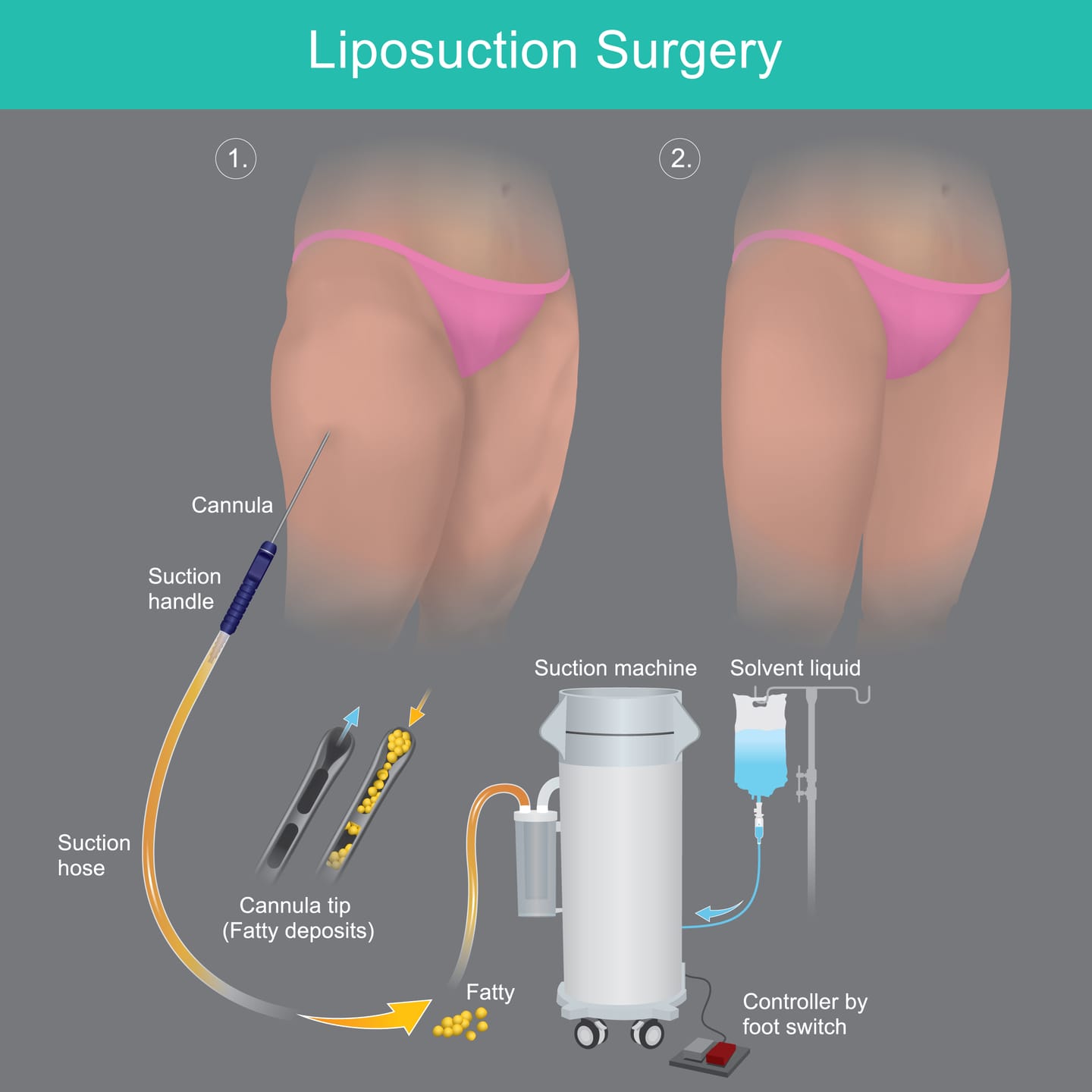
What it is
Liposuction removes fat from areas that are hard to slim down through diet and exercise, typically the buttocks, hips, thighs and tummy. Results are usually long-lasting if you keep a healthy weight. It suits people who are not overweight and whose skin is firm and elastic.
It is a different decision from a tummy tuck, which also removes loose skin: see tummy tuck. Liposuction is sometimes done at the same time as other operations, and a quote that adds "lipo" to another package should say how much fat is planned.
Who it is for, and who it is not for
It is not a treatment for obesity or weight loss, it will not remove cellulite or stretch marks, and it is suited to people who have tried lifestyle changes without success. In the UK it is generally not funded by the health service for cosmetic reasons; it may be used for lymphoedema or lipoedema.
Tell every clinician about clot risk factors: family history of clots, a BMI over 30, age over 40, a previous clot, and oral hormone replacement or the contraceptive pill. UK surgeons' guidance singles these out for particular attention.
How it is done in Türkiye
Liposuction is usually done under general anaesthetic (an epidural may be used for lower-body work) and takes 1 to 3 hours. Most people stay overnight. Fluid is injected into the area first to ease removal, and afterwards you wear an elasticated corset or compression bandages continuously for several weeks, removed for showering. After general anaesthetic someone should drive you home and stay with you for 24 hours.
A key figure is how much fat is removed. UK surgeons' guidance defines large-volume liposuction as 5 litres or more of total aspirate in one procedure, says there is no data to support a specific volume above which the operation stops being acceptable, and notes that the patient's body weight is probably the main factor; it encourages surgeons to limit aesthetic liposuction to about 5 litres and to split larger plans into stages. It also says high-volume liposuction combined with other procedures has resulted in serious complications and should be approached with caution. For large volumes, an American plastic-surgery position cited in the same guidance is that the operation should be performed in an acute-care hospital or a formally approved facility, with vital signs and urine output monitored overnight by competent staff.
Who may operate: in the register's own scheme this is a plastic, reconstructive and aesthetic surgery treatment; Turkish plastic surgery is a five-year specialty. Ask for the specialty and certificate in writing.
On facility type, the Ministry's rules for outpatient facilities let a medical centre operate only under a surgical permit limited to the specialties named on it; patients graded ASA 3 or above (a standard anaesthetic risk grade) cannot be operated on there, and observation is limited to 24 hours. A polyclinic may not run around the clock or have an emergency unit. A hospital can admit you overnight. We found no Turkish rule that sets a volume threshold by facility type, so ask for the planned volume and the place in writing.
The register records that a facility is authorised to treat international patients; each facility enters its own treatment list, and the authorisation does not certify the procedure.
What to check before you book
- The surgeon, by name, specialty, and that they will operate themselves: how to check a doctor.
- The place, type and authorisation number: how to read one.
- The planned volume of fat, areas, whether it will be staged, and whether anything else is done in the same session.
- The anaesthetist, named, present throughout.
- Overnight monitoring: where and by whom, especially if the volume is large.
- Clot prevention: a risk assessment, stockings or compression, movement and medication where appropriate.
- Your flight: public-health guidance is 5 to 7 days minimum; UK surgeons' guidance for general-anaesthetic operations up to three hours suggests staying 1 to 2 weeks (a week before and 2 to 4 weeks after for longer or multi-site surgery). Get clearance to fly in writing.
- The operation record: UK guidance lists what a record should contain, including height, weight, the fluid volumes infused and the volume of fat removed. Ask for those numbers.
- Follow-up: early review by the operating surgeon, then phone or video follow-up at home. See aftercare abroad.
What a package must state
- Areas to be treated and the planned maximum volume.
- Anaesthetic type, anaesthetist and surgeon names and specialties.
- Facility name, type, address and authorisation number, and where you spend the night.
- Compression garments, medicines and clot-prevention measures: included or charged separately.
- Consultations, review dates, and the minimum stay.
- Follow-up after you return, for how long, in which language.
- Who treats and who pays for a complication or a touch-up, and in which country.
- Documents you will be given, including the operation record with volumes.
Risks, complications and aftercare
Common after treatment: bruising and swelling lasting up to six months, numbness (usually settling in 6 to 8 weeks), scarring, inflammation of the treated area or veins, fluid leaking from the cuts, and swollen ankles if legs or ankles are treated. Possible complications: lumpy or uneven results, bleeding under the skin, numbness lasting months, skin colour changes, fluid in the lungs, a blood clot in the lungs, and damage to internal organs. General risks: heavy bleeding, a clot in a vein, infection and a reaction to the anaesthetic. Some people do not get the result they wanted and have another operation.
Recovery: stitches out after about a week unless dissolvable; walking is fine but avoid strenuous activity for the first couple of weeks; gentle exercise from about 3 to 4 weeks; no strenuous activity for 10 to 12 weeks without checking with the surgeon.
Contact the clinic promptly for severe pain or anything unexpected. See how to complain.
Questions to ask in writing
- Who will operate, with what specialty? Please send the certificate.
- What volume of fat is planned, from which areas, and is anything else done at the same time?
- Where do I spend the night, and who monitors me?
- Who is the anaesthetist, and are they present throughout?
- What clot-prevention measures will you use, and what is my risk assessment?
- How many days must I stay after surgery, and when will you confirm I may fly?
- Will I receive the operation record with volumes and fluids?
- Who treats a complication at home, and who pays?
- Can I see the contract and cancellation terms before paying any deposit?
To have a named clinic checked, see the Research Pass.
Frequently asked questions
Is liposuction a way to lose weight?
No. It is not a treatment for obesity or weight loss, and it does not remove cellulite or stretch marks. It suits people who are not overweight and whose skin is firm and elastic.
What does 'large volume' mean?
UK surgeons define large-volume liposuction as removing 5 litres or more of total aspirate in one procedure. They advise limiting aesthetic liposuction to about that figure and splitting larger plans into stages.
How soon can I fly home?
UK public-health guidance advises avoiding flying for 5 to 7 days after liposuction. The operating surgeon should decide and put it in writing.
When are the results final?
Swelling and bruising can last up to 6 months, so final results may take that long to show.
Is liposuction combined with other surgery?
Sometimes, for example with a tummy tuck. UK surgeons advise caution when large volumes are combined with other procedures, because serious complications have been reported.
This page is an information service, not medical advice. Clinimora is an independent, patient-funded research service. It does not sell treatment, does not diagnose and does not recommend any clinic.