
What it is
Breast reduction makes the breasts smaller. Under general anaesthetic the surgeon moves the nipple to a new position, usually while it stays attached to its blood supply, removes excess fat, glandular tissue and skin, and reshapes what remains. It takes 2 to 3 hours depending on how much is removed.
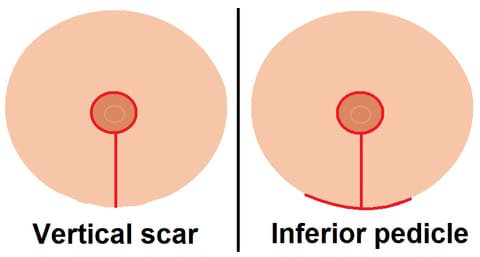
Scars are expected around the nipples and, depending on the technique, a vertical scar down the breast, or a vertical scar plus an anchor-shaped scar below the breast crease. They may look red or discoloured for the first six weeks; most fade and should be hidden by normal clothing, bras and bikini tops.
It differs from a breast lift, which removes loose skin and reshapes the breast, and from breast augmentation.
Who it is for, and who it is not for
People have breast reduction because the size of their breasts causes back, shoulder or neck pain, skin irritation under the breasts, grooves from bra straps, low self-esteem or low mood, or inability to take part in sport or exercise. In the UK the health service may fund it where other options such as professionally fitted bras have not worked and very large breasts cause health problems; breast size, weight, general health and smoking may also be considered. Criteria vary by area, and surgery for appearance alone is paid for privately.
Think about whether you plan children. You may be permanently unable to breastfeed after the operation, and breasts can enlarge again during pregnancy.
How it is done in Türkiye
Expect a general anaesthetic and a hospital stay of one or two nights. You wake with dressings and perhaps drainage tubes, which are usually removed after 1 to 2 days, after which you can usually go home. Pain for a few days is managed with painkillers. Stitches are usually dissolvable. Do not drive until wearing a seatbelt no longer hurts, which may take several weeks. Some surgeons advise a sports bra day and night for up to three months.
The register's own scheme files breast reduction under plastic, reconstructive and aesthetic surgery; Turkish plastic surgery is a five-year specialty. Ask for the surgeon's specialty and certificate in writing.
On facility type, the Ministry's rules for outpatient facilities let a medical centre operate only under a surgical permit limited to the specialties named on it; patients graded ASA 3 or above (a standard anaesthetic risk grade) cannot be operated on there, and observation is limited to 24 hours. A polyclinic may not run around the clock or have an emergency unit. A hospital can admit you overnight. Because this operation usually means one or two nights and drains, ask the facility to state in writing where you will sleep and who is on call.
The register records that a facility is authorised to treat international patients; each facility enters its own treatment list, and the authorisation does not certify the procedure.
What to check before you book
- The surgeon, by name, specialty, and that they will operate themselves: how to check a doctor.
- The place, type and authorisation number: how to read one.
- The technique, where the scars will lie, and how the nipple will be kept alive.
- Your reasons and your history: whether the surgeon has asked about pain, bras, weight, smoking and pregnancy plans.
- The anaesthetist, named, present throughout.
- Two consultations, the first in person, with a cooling-off period between them.
- Your flight: 5 to 7 days is the public-health minimum; get the surgeon's clearance in writing.
- Aftercare: who removes drains, who checks the wound, who you phone at home and in which language.
- Records: operation note, anaesthetic record, discharge summary and file: what to ask for. Ask also whether removed tissue is examined, and whether you will be given the result.
What a package must state
- The technique, and the planned scars.
- Surgeon and anaesthetist names and specialties; facility name, type, address and authorisation number.
- Nights in hospital and room type.
- Dressings, bras, drains and medicines: included or charged separately.
- Consultations, drain removal, review dates, minimum stay.
- Follow-up after you return, for how long, in which language.
- Who treats and who pays for a complication or revision, and in which country.
- Documents you will be given.
Risks, complications and aftercare
Breast-specific risks: thick, obvious scars; uneven breasts or nipples; wound-healing problems; loss of nipple sensation; permanent inability to breastfeed; loss of blood supply causing tissue death (necrosis); excess skin needing removal; and bleeding within the breast tissue (haematoma), usually within 24 hours. General risks: excessive bleeding, infection, an allergic reaction to the anaesthetic and deep vein blood clots. The surgeon should explain how likely each is and how it would be treated.
Swelling, tenderness and lumpiness are expected for around three months. Avoid stretching, strenuous exercise and heavy lifting for up to six weeks. Contact the clinic promptly for severe pain or anything unexpected, such as burning, unusual swelling or colour change. See aftercare abroad and how to complain.
Questions to ask in writing
- Who will operate, with what specialty? Please send the certificate.
- Which technique, and where will the scars lie?
- How will you protect the nipple and its feeling, and what loss should I expect?
- What are the chances I can breastfeed afterwards?
- Where will the operation take place, and where will I sleep?
- Who is the anaesthetist, and are they present throughout?
- How many days must I stay, and when will you confirm I may fly?
- Who removes the drains, and who reviews me after I go home?
- Who treats a wound or blood problem at home, and who pays?
- Can I see the contract and cancellation terms before paying any deposit?
Frequently asked questions
Can I breastfeed after a breast reduction?
You may be permanently unable to breastfeed after the operation. Breasts can also enlarge again during pregnancy, which may affect the result.
Will I lose feeling in the nipples?
Loss of nipple sensation is a possible complication. Ask the surgeon how the nipple will be kept attached to its blood supply and what loss of feeling you should expect.
How long should I stay in Türkiye?
UK public-health guidance advises avoiding flying for 5 to 7 days after breast surgery. UK surgeons' guidance for general-anaesthetic operations of up to three hours suggests 1 to 2 weeks in the destination. The surgeon should confirm in writing.
How long is recovery?
Full recovery takes 2 to 6 weeks, with 2 to 3 weeks off work. Swelling, tenderness and lumpiness are expected and may last around three months, and the final appearance is not visible until the swelling settles.
Is this covered by the UK health service?
Sometimes, if other options such as professionally fitted bras have not worked and very large breasts cause health problems. Criteria vary by area, and surgery for appearance alone is paid for privately.
This page is an information service, not medical advice. Clinimora is an independent, patient-funded research service. It does not sell treatment, does not diagnose and does not recommend any clinic.